Sichuan University questions and answers
Loading video player...

"The night of April 27, 2013"
(i) Question: The fact that people are now spending a great deal of money on such things as the restoration of Buddha statues is contrary to mainstream values. I think it's better for Buddhism to be alive, to spend money on charity or where it should be spent. What do you think?
A: Donations of Buddha statues, monasteries, etc. have existed since ancient times. The construction of monasteries, which now cost millions, tens of millions of dollars, and the loss of hundreds of millions of dollars in Handu, depend on donations, and the amount of money is indeed considerable. But it depends entirely on the will of the individual, and the people who pay for it demand it, we make it, and we don't allow it to be used for other purposes; if he wants to be charitable, we do charity, we don't make it.
I personally value education more than statues and monasteries. I even believe that, in a sense, more money is spent on training people from within and outside Buddhism, more than the work of plastic Buddhas. Nevertheless, we respect the heart of God.
(ii) Question: From the 1980s onwards, GMO technology has begun to engulf the world, also affecting religion. I note that the issues related to transgenics do not appear in the Bible as a reason for European religious opposition to transgenics. But I wonder, what do you think of this technology? What are your thoughts on how Chinese society can cope with the tide of transgenics?
A: In many cases of Buddhist Vineiya, there are often some reasons that make people at the time and now feel very rare and strange, which reminds me of understanding the issues of transgenics, cloning and so forth. There are specific reasons for each and every one of them, and there are a variety of them that can be generally accepted and recognized, some that are not recognized or even excluded, but in fact, none of them is out of context.
In general terms, causality is the proximity factor, which is the primary cause, the internal factor and the external side. So in this context, let me understand that the success of transgenics is due to the changes made to it, not to the reasons.
So, from a Buddhist point of view, it's by nature: everything, it's by nature, it's by nature. You don't admit it. It already exists. Now and for centuries to come, this will happen.
As for what it would become in China, it is difficult to say now, because it follows many different views behind it, and it is difficult to explain either side if it contradicts certain points of view. It's time to find out.
(iii) What are your views on the death penalty? As society moves towards harmony, do you believe that the death penalty will be abolished and other criminal laws used?
A: All the classics, such as the Book of Light and Light, believe that the death penalty should not be used. The Confucian is also cautious about this. The king asked Mengko if he should be killed. Menko said, " The ministers on the right and on the left say they can kill, so do not listen; the doctors, or the leaders who say they have considerable responsibility, say they can kill, nor are they anxious; and if the people of the country say that this man must kill, then they will examine him and find him capable of killing before he can be sentenced to death.
This is the tradition of German governance, from Confucius to Meng, which advocates the teaching of people with virtue and courtesy, not with punishment. I have also been used by many kings for their inaction, because they are more gentle and responsive. However, given the context of the times, it seems unlikely that, in today ' s social context, a purely moral sentence will be imposed.
So, as far as I personally understand it, it would be much better if the sentence of life imprisonment were taken into account the pitiful and painful circumstances in which the offender was sentenced to death. However, every State and local has its own laws and regulations, and no religion can interfere with them unless they are complied with. Religion is also subject to the laws of the land, sometimes in accordance with Buddha ' s precepts, and such acts are punishable under local law.
Buddhists would not have been allowed to kill life, even in vicious animals, a concept under which Buddhists could certainly not have carried the death penalty. I believe, however, that its use or abolition will have different considerations in different times and countries.
(iv) Question: What is faith? Can the law serve as a faith?
答:从广义上讲,法律也是一种信仰。或者说,如果你特别喜欢钱,也是对钱有信仰;喜爱无神论,就是对无神论有信仰……但要从狭义理解,它是单指对宗教的。
起先我不明白,你们学院让我讲的信仰是指什么,来的路上我还在想,既然是和科技、法律一起讲,应该是指宗教了,就是狭义的信仰——“你有没有信仰”,指这个。这就不是信仰法律那种了,执法人员也不一定有信仰。那天我在哥廷根和个别人在思想上有冲突,就是因为这个。
回过来讲,当你对某种思想或事物产生了一定的信赖和仰慕,甚至是兴趣和投入,就是信仰。在这种广义理解上,我觉得法律重要,我相信法律,那我就是信仰法律。
主持人:我补充一句,哥廷根只有 12万人口,却出了45 位诺贝尔奖获得者,很不简单。一座诺贝尔奖大城。
(五) 问:现在很提倡藏传佛教与社会相适应,这是否意味着,藏传佛教的神圣性将被削弱,变得世俗化?
答:朱老师说得对,12 万人里有 45 位诺贝尔奖得主,确实让人惊讶。也许这跟他们喜欢传统有关:在哥廷根大学,北大季羡林先生的房子还在;在德国,两三百年甚至七百年前的房子还在;他们的思想也不是今天这个、明天那个;车子没坏之前是不会换的;买栋房子就一辈子住在里面……他们似乎不寻求改变,不像其他地方的人,变来变去。
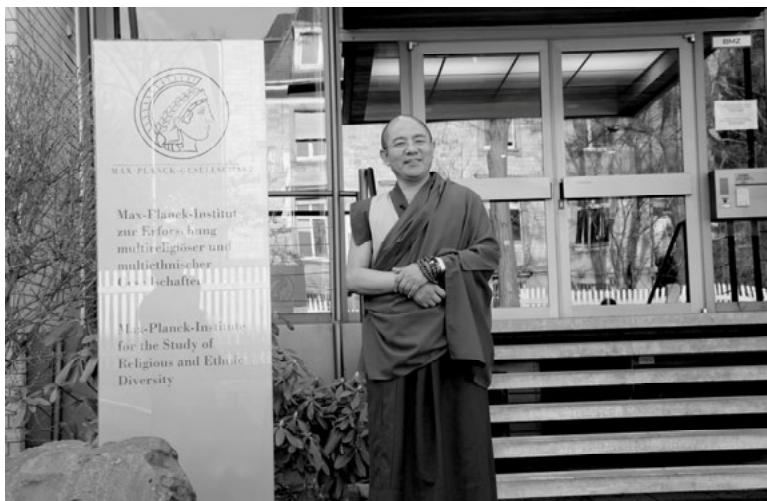
我在哥廷根大学参观了一个地方,那里摆着十三个诺贝尔奖纪念碑,都摆在一起,包括马普研究所创始人马克斯·普朗克(1918年诺贝尔物理奖得主),物理学家马克斯·玻恩(1954年诺贝尔物理奖得主)等。有趣的是,这种将荣誉集结一处的现象,并非独有,我在哥伦比亚大学发现,那里也涌现过 98位诺贝尔奖得主;哈佛大学也一样,除了上百位诺贝尔奖得主外,还培养了包括奥巴马在内的 8 位美国总统。
我不知道这些学校有什么共同性,不过,老师们强调并引导灵活性思维,或许是一个因素。他们似乎喜欢学生提怪问题,一提怪问题,“嗯,这个孩子很有创意。”这也确实比一般的灌输好,能够启发开放的思维能力。
我对一位德国学者说:“你们这种教育方式和藏地的辩论差不多,我们辩论时,也一定要提最尖锐的问题,要刁难对方,这样才能对自他的智慧增长,起到最大的帮助。”
回到你的问题上。现在有很多专家在研究怎样把佛教变得世俗化,因为社会这么进步,这么科技化,佛教要生存其中也得通俗一点。但通俗的后果,我觉得有两种可能:
一种是不变味。例如藏传佛教,只要能保持原有的讲辩著体系以及培训方法,不损失主体,那它的生命力就可以贯穿到今天,进入任何文化或知识分子群体,都不会变味。同时也能适应时代,因为它有理论——就是这套经得起科学最严厉质疑的思辨方式,让它不至于沦为简单的感性信仰。
在今天的西方,很多老年人爱学其他宗教,但年轻人喜欢藏传佛教,为什么呢?因为它可以跟科学同步。爱因斯坦不是说过,“任何宗教如果有可以和现代科学共依共存的,那就是佛教。”“那就是佛教”,很多成分指的就是逻辑学。
当然也包括其他学问。当年法尊法师入藏求学,学因明、学密法,也学历史、地理、文艺、工巧甚至政治学,他学的不仅是宗教,是多元的文化,而这些在藏传佛教里都有。
举个例子,比如天文学,我们佛学院有一个六七位喇嘛的团队,他们不依靠任何仪器,用时两个月,就可以把明年的日历提前写出来,包括所有日食、月食的准确时间。这是很高级的天文历算,我亲眼所见,不是吹嘘。藏传佛教之所以能折服今天的很多知识分子,应该是有原因的。
那么,如果是这种原汁原味的藏传佛教进入市场,以融入的方式被世俗化一些,是不会改变的。
还有一种可能是,如果没有保留传统,也没有掌握佛教原本的思想精髓,直接世俗化,那可能就要变味了。
主持人:我再补充一句,今年我参加了中国藏学会第三次北京论坛,分的组就有天文、历算、医学、建筑、美术、音乐、哲学……有一个上海复旦大学的博士,就在社科院学因明,从哲学角度研究藏传佛教的因明学。这次活动分得很细,而且很官方,三百多人,分了若干组,由中国藏学研究会举办,国家非常重视。堪布讲到这,我也顺便证实一下,确实有很多现代科学也在研究藏传佛教。
(六) 问:当下中国有一种社会现象,老人倒了没人扶、小孩被车轧了没人救,这都是之前法院的判决先例对善心人士不利导致的,伤害了人们见义勇为的热情。法律不鼓励,所以大家想做而不敢做,请问对此您是怎么看的?
答:我没有丧失希望,个别现象总归是个别现象。
前段时间,复旦大学一名研究生被同学毒死了,到处在传,这和你说的那些事件一样,也是个别现象,不代表学校如何、整个社会如何。人们对佛教的看法也是如此,一个人不如法,不代表所有佛教徒、所有佛教团体都不如法。只要跳出那些报道,擦亮眼睛看看,社会也没有那么不好。
同样的,一个人做好事,也不代表整个社会都那么好。
凡事要一分为二地看。
问:那该怎样运用法律或信仰,解决好这些问题呢?
答:二者都取其优点、补其不足,应该能解决很多问题。
法律有强制性,案件发生了,由法官依法判决,立竿见影,这是法律的优势。但在犯案前、做坏事还没构成犯罪或犯罪后没被发现时,法律就没办法了。这时要靠信仰。信仰有自律性,即使没人看着,也不会偷东西、不会干坏事,内心的自我约束力量,让他不会去犯法。然而,事有偶然,一旦犯了罪,信仰就无能为力了,这时候要用法律。
所以,二者相辅相成、缺一不可,既要提高法律意识,也要提高信仰意识。光是依赖法律,从许多国家的现状看,也并未达到理想的治理状态;只用信仰守护,不说现在,就是 2500 多年前佛陀在世时,也很难控制得好。
听课笔记
登录后可记录与自动保存听课笔记 To log in.